Early-Life Prevention of Food Allergy: A Narrative Review of the Evidence and Its Translation into Practice
Sawsañ H Hàshim¹, Abdullah K Abusoliman²˒*, Kinda A Abaalkhayl³, Mohammed I Asiri⁴, Hoor H Alqurashi⁵, Raghd M Ali⁶, Shahad S Aloufi⁷, Suliman M Aldhalaan⁸, Abdulrahman A Alharbi⁹, Waleed S Alqahtani¹⁰, Fahad S Alsubaie¹¹, Nouf A Alsayed⁹, Raghad K Alqurashi⁵, Alhanouf R Alruwaili¹², Maryam A Alnashri⁹
1 Department of Pediatrics, Northern Border University, Arar, Saudi Arabia.
2 King Abdulaziz University, Jeddah, Saudi Arabia.
3 King Saud Bin Abdulaziz University for Health Sciences, Riyadh, Saudi Arabia.
4 Najran University, Najran, Saudi Arabia.
5 Taif University, Taif, Saudi Arabia.
6 Mansoura University, Mansoura, Egypt.
7 Taibah University, Medina, Saudi Arabia.
8 Hafar Al-Batin Health Cluster, Hafar Al-Batin, Saudi Arabia.
9 Umm Al-Qura University, Al-Qunfudhah, Saudi Arabia.
10 King Saud University, Riyadh, Saudi Arabia.
11 Ministry of Health, Riyadh, Saudi Arabia.
12 Vision College, Riyadh, Saudi Arabia.
Corresponding author
*Abdullah K Abusoliman — King Abdulaziz University, Jeddah, Saudi Arabia.
Email: Researchup9988@gmail.com
Received: July 19, 2026 | Accepted: August 23, 2026 | Published: August 31, 2026
Cite this article as
Hàshim SH, Abusoliman AK, Abaalkhayl KA, et al. Early-Life Prevention of Food Allergy: A Narrative Review of the Evidence and Its Translation into Practice. DawnMed Journal 2(3):50–59 https://doi.org/10.64039/djms.2026.2307
Volume 2, Issue 3,2026
Pages: 50-60
Full Text
1. Introduction
Food allergy has become a common paediatric concern over a single generation. Prevalence estimates vary widely with methodology, and the gap between self-reported and challenge-confirmed disease is wide enough that the two figures should not be compared directly; even so, studies using oral food challenge in high-income settings have reported rates approaching one in ten infants, and the trend over the past two decades has been upward across most regions with serial data (1). The clinical consequences are familiar: cutaneous, gastrointestinal, respiratory and cardiovascular reactions, occasionally progressing to anaphylaxis. Those that fall outside the clinic are less often measured but are substantial, and include restricted diets during periods of rapid growth, curtailed social participation, sustained caregiver anxiety and considerable direct and indirect costs (2).
Ascertainment alone does not account for the rise. Better recognition and easier access to testing explain part of it, but not the geographic patterning, the speed of change in migrant populations, or the concentration of risk in infants with early-onset eczema. The prevailing explanation is an interaction between genetic susceptibility, epithelial barrier function, microbial exposure and the timing and route of first contact with dietary protein, all operating within a developmental window in the first year of life (1, 3).
This understanding has had a direct effect on practice. For roughly two decades several national bodies advised deferring peanut, egg and other allergenic foods, in some cases into the third year, reasoning that avoiding exposure would avoid sensitisation. That advice rested on expert opinion and observational inference rather than trial evidence (2, 4). Prevalence continued to climb while it was in force, and the observation that populations with early and habitual peanut consumption had markedly less peanut allergy than otherwise comparable populations that avoided it pointed to the opposite conclusion. A series of randomised trials tested that possibility directly, and the guidance was reversed (5, 6).
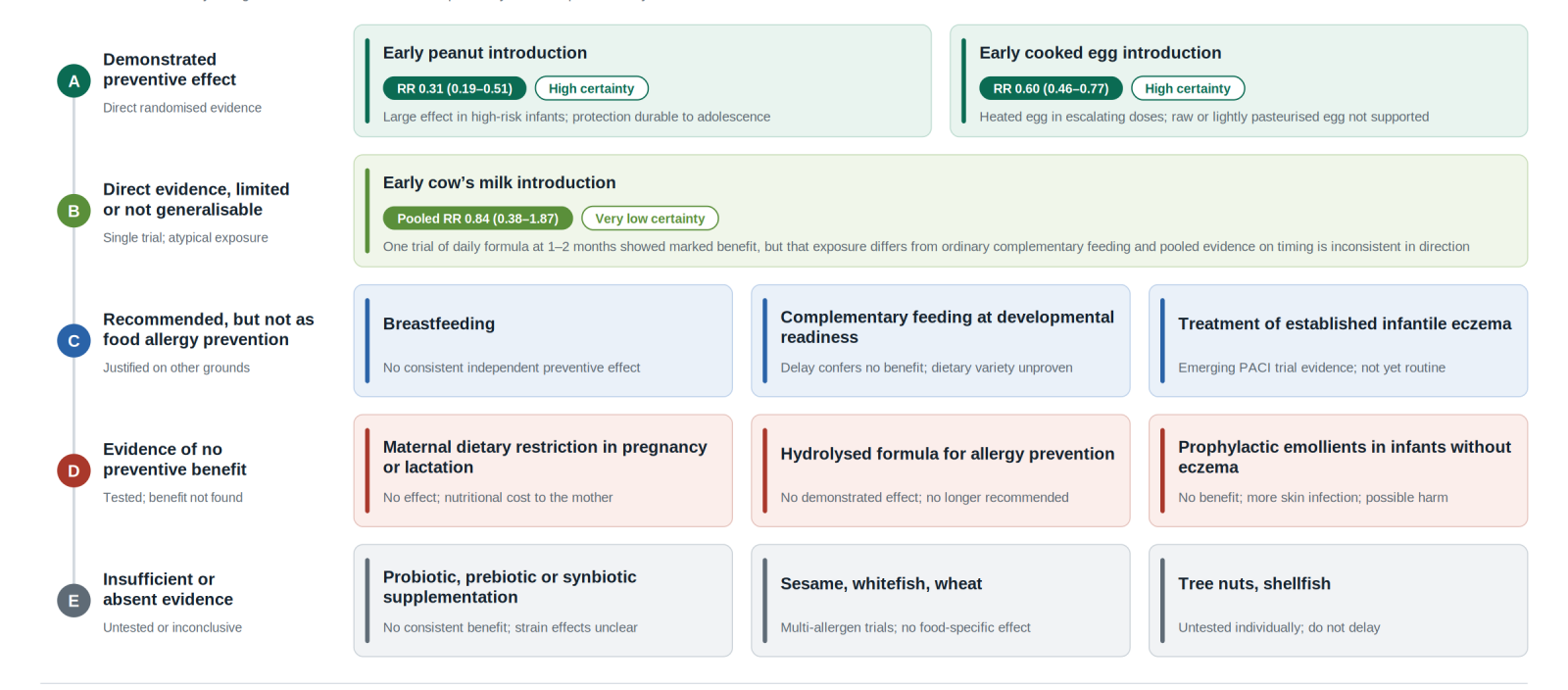
The reversal is now well established, though its edges are less clearly defined than the summary statements in guidelines imply. Which infants to target, whether to screen before introduction, how much of which food and for how long, and what to expect at population rather than trial level are all incompletely resolved, and the operational detail that determines whether introduction is done safely is frequently lost when the evidence is condensed for practice. Around early introduction sit several adjacent strategies covering breastfeeding, complementary feeding practice, maternal nutrition, skin barrier care and microbiome modulation, often presented together as a single preventive package despite resting on evidence of very different quality. This review sets out what is established, separates it from what is plausible but unproven, and considers what lies between the evidence and its delivery, with reference to the Saudi Arabian setting. Figure 1 groups the strategies discussed below by the strength of the evidence supporting each.
Figure 1. Early-life food allergy prevention: interventions grouped by strength of evidence. Categories correspond to Table 2 and are not ranked against one another. Band D contains interventions tested and found not to confer benefit, which is a different conclusion from band E, where the evidence is insufficient or absent. Placement reflects the evidence for preventing IgE-mediated food allergy rather than the general health value of the practice.
1.1 Scope and approach
This is a narrative review and makes no claim to exhaustive retrieval. We identified literature through targeted searching of PubMed and ScienceDirect, with the final search run in July 2026, supplemented by hand-searching the reference lists of major trials, guidelines and prior syntheses and by citation tracking forward from the landmark trials. Search concepts combined food allergy or food hypersensitivity with prevention, and with infancy, pregnancy, breastfeeding, complementary feeding, allergen introduction, skin barrier or microbiome. Only English-language publications were considered.
We gave priority to randomised controlled trials, to systematic reviews with pooled estimates, and to current international guidelines. Observational and mechanistic work is drawn on where it explains a finding or addresses a question the trials have not. Where trials disagree, both the positive and the negative results are reported, and where a pooled estimate exists it is preferred to any single trial. No formal risk-of-bias instrument was applied and no protocol was registered.
Three limitations follow from this design. Restricting the search to two databases and to English will have excluded relevant work, particularly from regions where allergy research is published locally. Selection was purposive, so the evidence set reflects editorial judgement rather than a reproducible algorithm. The evidence-strength labels used in Table 2 are our summary judgements of volume, consistency and design; they are not GRADE assessments and should not be read as such.
2. Immunological basis of early-life prevention
Oral tolerance is an active process, not simply the absence of a response. Dietary protein sampled across the intestinal epithelium is presented in a tolerogenic context by CD103⁺ dendritic cells within gut-associated lymphoid tissue, which drives induction of antigen-specific regulatory T cells that suppress effector responses on re-encounter (3). This capacity is not uniform across the lifespan. It appears most readily engaged during a period in infancy when the mucosal immune system is being calibrated by simultaneous exposure to food antigen and to colonising microbiota, the reasoning behind the concept of a window of opportunity for dietary intervention (7).
The dual-allergen exposure hypothesis accounts for how sensitisation occurs when tolerance does not. In this model, cutaneous exposure to food protein through inflamed or barrier-defective skin promotes a Th2-skewed, IgE-producing response, whereas early oral exposure to the same protein promotes tolerance; the balance between the two routes, and their relative timing, determines the outcome (8). The model fits several well-replicated observations: the strong association between early-onset severe eczema and later food allergy, the link between filaggrin loss-of-function variants and peanut allergy, and the detection of food protein in household dust in quantities that correlate with sensitisation. Prophylactic emollient trials have not established a preventive benefit against food allergy; treatment of established eczema is considered separately in Section 7.
Microbial colonisation shapes both processes. The composition and diversity of the infant gut microbiome is influenced by mode of delivery, gestational age, antibiotic exposure, feeding and household environment, and microbial metabolites, notably short-chain fatty acids, support regulatory T cell induction and epithelial integrity (9). Associations between altered early colonisation and later allergic disease are reproducible across cohorts. Whether they are causal, and whether they can be modified to therapeutic effect, are separate questions the intervention literature has not answered affirmatively.
These mechanisms explain why timing matters, but they do not amount to a menu of interventions of equal standing: each identifies a plausible target, and so far only early oral exposure has produced a preventive effect that replicates across trials.
3. Early introduction of allergenic foods
3.1 The trial evidence
The Learning Early About Peanut Allergy (LEAP) trial randomised 640 infants aged 4 to 11 months with severe eczema, egg allergy or both to regular peanut consumption or to avoidance until 60 months (5). Among infants with a negative baseline skin prick test, peanut allergy at 60 months occurred in 13.7% of the avoidance group and 1.9% of the consumption group. Among those with a positive baseline test, the figures were 35.3% and 10.6%. The effect was large, was present in already-sensitised infants, and came without excess adverse events under supervised introduction, which is why the trial reoriented the field.
Two follow-up studies address durability. LEAP-On withdrew peanut from both groups for 12 months and found that protection persisted, indicating that the effect does not depend on uninterrupted consumption once established (10). LEAP-Trio followed the original cohort to adolescence and reported peanut allergy in 4.4% of the early-introduction group compared with 15.4% of the avoidance group, with participants free to eat peanut as they chose in the intervening years (11). Durability here is an observed finding, not an assumption.
The Enquiring About Tolerance (EAT) trial asked a different question in a different population: whether introducing six allergenic foods from three months of age would reduce food allergy in 1,303 exclusively breastfed infants drawn from the general population rather than selected for risk (12). The intention-to-treat analysis was negative, with food allergy in 5.6% of the early-introduction group and 7.1% of the standard-introduction group. Per-protocol analysis, restricted to those who achieved the target intake, showed 2.4% versus 7.3%. Roughly 42% of the early-introduction group met the per-protocol criteria, and a dedicated analysis identified maternal-reported feeding difficulty, infant refusal and eczema as the main barriers (13). The two analyses have been read very differently. The per-protocol result is open to confounding, since infants who tolerate an intensive early regimen are plausibly those at lower underlying risk. The intention-to-treat result describes what happens when an ambitious protocol meets ordinary families, and it is the more useful of the two for policy. Secondary accounts that quote the per-protocol figure alone give a misleading impression of what the trial showed.
The PETIT trial randomised 147 Japanese infants with atopic dermatitis to stepwise introduction of heated egg from six months or to placebo, with active eczema management in both arms (14). Egg allergy at 12 months occurred in 8% of the intervention group and 38% of the placebo group. Two features of the design matter as much as the effect size: eczema was treated in both arms, which separates the dietary effect from that of skin management, and the egg was heated and escalated gradually. The trial was small and was stopped early at interim analysis, which tends to inflate effect estimates, and hospital admissions were more frequent in the egg group (6 of 60 versus 0 of 61) even though acute reactions to the trial powder itself were comparable.
The wider egg literature is less uniform than PETIT alone suggests, and the difference turns largely on the form of egg used. Trials introducing raw or pasteurised egg powder reported high rates of reaction at first exposure, substantial withdrawal, and no convincing reduction in challenge-confirmed egg allergy. The trials that showed benefit used cooked or heated egg in escalating amounts. A meta-analysis of 23 trials and 13,794 participants graded the evidence for timing of egg introduction as high certainty, pooling nine trials and 4,811 participants to a relative risk of 0.60 (95% confidence interval 0.46 to 0.77); the corresponding figure for peanut was 0.31 (0.19 to 0.51) across four trials and 3,796 participants, also graded high certainty. The same analysis reported increased withdrawal from intervention arms (15). These are the review authors’ own GRADE ratings and are the strongest certainty assessments available in this field. In practical terms, the positive evidence supports cooked egg introduced gradually; raw or lightly pasteurised egg is not an acceptable substitute.
Two further trials extend the evidence beyond peanut and egg. PreventADALL used a factorial design in 2,397 infants from the general Norwegian and Swedish population to test early food introduction from three months and skin emollients from two weeks (16). Early food introduction reduced food allergy at 36 months, driven largely by peanut, while emollients did not. Because baseline risk in an unselected population is low, the absolute benefit was small, with a number needed to treat of approximately 63, the expected result of applying a preventive intervention outside a high-risk group. The SPADE trial randomised newborns to daily ingestion of a small volume of cow’s milk formula from one to two months of age or to avoidance, and reported cow’s milk allergy at six months in 0.8% of the ingestion group compared with 6.8% of the avoidance group (17).
Table 1 summarises these trials.
Table 1. Randomised controlled trials of early allergen introduction
Trial (first author, year)
Population
Intervention
Primary outcome
Result
Safety and adherence
LEAP (Du Toit, 2015)
640 infants aged 4–11 months with severe eczema, egg allergy or both
Regular peanut consumption vs avoidance to 60 months
Peanut allergy at 60 months
SPT-negative 1.9% vs 13.7%; SPT-positive 10.6% vs 35.3%
No excess adverse events under supervised introduction
LEAP-On (Du Toit, 2016)
LEAP cohort
12 months of peanut avoidance in both groups
Peanut allergy at 72 months
Protection retained after cessation
Not applicable
LEAP-Trio (Du Toit, 2024)
LEAP cohort followed to adolescence
Unrestricted diet after trial
Peanut allergy in adolescence
4.4% vs 15.4%
Not applicable
EAT (Perkin, 2016)
1,303 exclusively breastfed infants, general population
Six allergenic foods from 3 months vs standard introduction at 6 months
Food allergy to ≥1 of six foods, 1–3 years
Intention-to-treat 5.6% vs 7.1% (non-significant); per-protocol 2.4% vs 7.3%
Approximately 42% met per-protocol criteria; refusal and feeding difficulty the main barriers
PETIT (Natsume, 2017)
147 infants with atopic dermatitis, Japan
Stepwise heated egg from 6 months vs placebo, eczema treated in both arms
Egg allergy at 12 months
8% vs 38%
Stopped early at interim analysis; hospital admissions 6/60 vs 0/61
PreventADALL (Skjerven, 2022)
2,397 infants, general population, Norway and Sweden
Factorial: early food introduction from 3 months and/or emollients from 2 weeks
Food allergy at 36 months
Food intervention reduced food allergy, mainly peanut; number needed to treat approximately 63. Emollients showed no effect
Not applicable
SPADE (Sakihara, 2021)
Newborns, Japan
Daily cow’s milk formula from 1–2 months vs avoidance
Cow’s milk allergy at 6 months
0.8% vs 6.8%
Exposure pattern differs from ordinary complementary feeding
Table 1. Trials are ordered by allergen and by publication year. Effect estimates are reported as given in the source publications. Section 3 sets out the interpretive limits of the per-protocol analysis in EAT, of early stopping in PETIT, and of absolute risk reduction in unselected populations. SPT = skin prick test.
3.2 What the trials do not settle
The consistency of the peanut and cooked-egg findings can give a misleading impression of how narrow the evidence base is elsewhere. Five issues recur.
The first is generalisability. LEAP and PETIT enrolled infants selected for eczema or existing allergy, so their findings require consideration of the populations studied. Results from unselected populations differed between trials. EAT did not demonstrate a statistically significant reduction in its primary intention-to-treat analysis (12). PreventADALL found a statistically significant reduction in food allergy at 36 months in its intention-to-treat analysis, with a risk difference of −1.6 percentage points (95% CI −2.7 to −0.5) and a number needed to treat of approximately 63 (16). This was a modest absolute benefit. Absolute benefit depends on baseline risk, and findings from high-risk cohorts should not be assumed to apply unchanged to unselected infants.
The second is screening. The NIAID addendum guidelines recommended stratification by eczema severity and existing egg allergy, with specific IgE or skin prick testing before peanut introduction in the highest-risk group (18). Later guidance from North American and European bodies has moved away from routine pre-introduction testing, on the grounds that it delays introduction, generates false positives that lead to unnecessary avoidance, and requires access to allergy services that most settings cannot provide (6, 19). No trial has randomised one screening strategy against another, so the divergence turns on judgement about competing harms rather than comparative data, and that remains the position as of mid-2026.
The third is maintenance. LEAP prescribed a defined weekly peanut intake sustained over years, and LEAP-On and LEAP-Trio show that protection persists after that period without continuous consumption (10, 11). What has not been tested is whether a brief or interrupted course in the months immediately after first introduction confers the same protection. Guidelines that describe regular ongoing consumption reflect the protocols as they were run, and the durability data should not be taken to license a single introduction followed by neglect (20).
The fourth is the range of foods. Peanut, cooked egg and cow’s milk have direct trial evidence, though of differing strength. Sesame, whitefish and wheat were randomised within the EAT multi-allergen regimen, and wheat within PreventADALL, but neither trial demonstrated food-specific efficacy for them, so these foods have been tested without being shown to benefit (12, 16). Tree nuts and shellfish remain essentially untested as specific preventive interventions (21, 22). Advice not to delay these foods is reasonable, but it rests on the absence of any demonstrated harm from early introduction, not on demonstrated benefit, and should be described in those terms rather than presented as equally evidenced with peanut.
The fifth concerns cow’s milk. SPADE is a well-conducted trial with a striking result, but it tested daily formula supplementation from one to two months of age, a different exposure from the ordinary introduction of dairy at complementary feeding. The wider literature on timing of cow’s milk introduction is inconsistent in direction and was graded very low certainty in the same pooled analysis, across six trials and 3,900 participants, with a relative risk of 0.84 (95% confidence interval 0.38 to 1.87) (15). Set against the high-certainty peanut and egg estimates from that analysis, this is the plainest indication of how unequal the evidence base is. A separate concern is that transient formula supplementation in the first days of life, followed by a return to exclusive breastfeeding, may itself promote sensitisation, a question about the pattern of exposure rather than its timing. Cow’s milk should therefore be treated separately from peanut and cooked egg when evidence is summarised. Hydrolysed formula, once recommended for allergy prevention in at-risk infants, is not supported for that purpose by current evidence and is no longer recommended (6).
4. Breastfeeding
Breastfeeding is recommended for reasons that do not depend on food allergy. Human milk supplies secretory IgA, lactoferrin, cytokines, growth factors and human milk oligosaccharides that shape gastrointestinal maturation, epithelial integrity and microbial colonisation, and the case for exclusive breastfeeding to around six months rests on a broad and settled evidence base (23).
Whether breastfeeding prevents IgE-mediated food allergy specifically is a narrower question with a less satisfying answer. Systematic reviews have not found a consistent protective effect, and the observational literature is hard to interpret because of reverse causation, since families with allergic disease often breastfeed longer and avoid allergens for longer (4, 24). Duration, exclusivity, maternal diet, infant genotype and outcome definition all vary between studies, and the heterogeneity is large enough that pooled estimates are of limited value.
The apparent tension between exclusive breastfeeding to six months and allergen introduction from around four months is a common source of confusion in counselling, and it is worth setting out plainly because three distinct ages are often conflated. Guidelines set a target of exclusive breastfeeding to about six months; complementary foods, including allergenic ones, are introduced when the infant is developmentally ready, usually between four and six months and not before four; and the trials themselves began earlier, at three months in EAT and PreventADALL and at four to eleven months in LEAP. Current guidance resolves the tension by recommending that allergenic foods be introduced alongside continued breastfeeding once readiness is reached, in small amounts that do not displace milk feeds (6, 19). Breastfeeding should be supported for its established benefits, and should not be offered to parents as a food allergy preventive in its own right.
5. Complementary feeding and dietary diversity
Deferring solid foods beyond the recommended window does not reduce food allergy risk, and it forfeits part of the period during which tolerance is most readily induced (4, 12). Introduction at developmental readiness, generally between four and six months, remains the position of most guidelines (19).
Dietary diversity in the first year has been associated with reduced allergic disease in several birth cohorts, usually measured as the number of distinct foods introduced before 12 months. The association is reasonably consistent, but it remains observational, and diversity is hard to separate from the family characteristics and feeding circumstances that produce it. No trial has tested diversity as an isolated intervention, and the EAACI complementary feeding guidance treats it as a reasonable component of healthy infant nutrition rather than a demonstrated preventive measure (19). There is no reason to restrict the variety of an infant’s diet in the absence of diagnosed allergy, and some reason to encourage it, but diversity should not be presented as an intervention comparable to allergen introduction.
6. Maternal and perinatal factors
Restricting the maternal diet in pregnancy or lactation does not prevent food allergy in the offspring and carries a nutritional cost to the mother. This has been examined repeatedly, and the conclusion is stable across reviews and guidelines: allergenic foods should not be excluded from the maternal diet without a clinical indication (4, 24).
Attention has shifted to whether maternal nutritional status modifies risk. Vitamin D, long-chain omega-3 fatty acids, folate and overall dietary pattern have all been examined. Trial results have been inconsistent and generally null for food allergy as a primary outcome, and the observational associations are open to confounding by socioeconomic and dietary factors that are difficult to adjust away (24). Similar caution applies to perinatal exposures such as caesarean delivery, intrapartum and infant antibiotics and maternal obesity, each associated with allergic outcomes in cohort studies without evidence that modifying them prevents food allergy.
Standard antenatal care, meaning adequate nutrition, avoidance of tobacco and appropriate management of maternal conditions, is justified on its own terms. Recasting it as allergy prevention overstates what is known and risks implying that a mother is responsible for an outcome the evidence does not show she can control.
7. Skin barrier interventions
The mechanistic case for skin barrier interventions is strong, which is what makes the trial results instructive. If transcutaneous exposure through defective skin drives sensitisation, prophylactic emollient use from birth should reduce both eczema and food allergy. Two large randomised trials tested this. The BEEP trial randomised 1,394 high-risk newborns to daily emollient for the first year and found no reduction in eczema at two years, together with more reported skin infections in the intervention group; food allergy at two years was numerically higher, not lower, in the emollient arm (25). PreventADALL likewise found no preventive effect from emollients on either eczema or food allergy (16).
A Cochrane review pooling the available trials concluded that skin care interventions in infancy probably do not prevent eczema (26). Its two harm signals differ in weight and should not be treated as equivalent. The increase in skin infection was supported by six trials with moderate-certainty evidence. The food allergy signal rests on a single trial of 976 participants, with a relative risk of 2.53 and a 95% confidence interval of 0.99 to 6.49, and was graded low certainty; it is grounds for caution rather than an established harm.
Taken together, the evidence supports a firm conclusion about the recommendation and a cautious one about the mechanism. Prophylactic emollients should not be offered to prevent eczema or food allergy, and the possibility that they do net harm cannot be dismissed on current data.
The failure of these trials does not overturn the dual-allergen exposure hypothesis. It shows that the emollients tested, applied as they were applied, do not correct the relevant defect. Whether earlier initiation, different formulations, or targeting infants with filaggrin variants would perform differently is unknown (8).
Treatment of established eczema has been evaluated separately from prophylactic emollient use. The PACI randomised trial compared enhanced topical corticosteroid treatment with conventional reactive treatment in infants aged 7–13 weeks with atopic dermatitis. Among 640 infants analysed, challenge-confirmed egg allergy at 28 weeks occurred in 31.4% of the enhanced-treatment group and 41.9% of the conventional-treatment group (P = 0.0028). However, mean body weight and height were lower with enhanced treatment. These findings support a potential preventive benefit, but the regimen requires modification and further safety evaluation before adoption specifically for food-allergy prevention (27).
For clinical purposes, eczema in infancy should be treated well because it warrants treatment in its own right, and because infants with early severe eczema are the group in whom timely allergen introduction matters most.
8. Gut microbiome modulation
The rationale for microbiome-directed prevention is the same as the rationale for its role in tolerance: colonisation patterns differ between children who develop food allergy and those who do not, and the differences appear before disease onset (9). Whether supplementation reproduces the protective pattern is another matter.
Trials of probiotics, prebiotics and synbiotics for primary prevention of food allergy have been heterogeneous in organism, dose, timing and recipient, and have not produced consistent benefit. Individual meta-analyses have reported favourable pooled estimates, but these generally combined dissimilar products and outcome definitions, and the reviews and guidelines that appraised them did not find the evidence sufficient to support a recommendation. Systematic reviews and guidelines have accordingly declined to recommend routine supplementation for this indication, a position distinct from the more favourable, though still contested, evidence in eczema prevention (4, 9, 24). Strain-specific effects remain plausible and would not be detected by pooling across products, so the absence of a demonstrated effect is not the same as a demonstrated absence of effect.
Measures that shape colonisation without supplements rest on firmer ground: breastfeeding, avoiding antibiotics where they are not indicated, and timely dietary diversification. Whether these translate into measurable reductions in food allergy has not been shown, and they are recommended on their general merits.
Table 2. Preventive strategies, evidence status and practice implications
Strategy
Principal evidence
Strength
What the evidence shows
Practice implication
Early peanut introduction
LEAP, LEAP-On, LEAP-Trio, PreventADALL, EAT; pooled analysis; guidelines
High (source-level GRADE; RR 0.31, 0.19–0.51)
Large reduction in peanut allergy in high-risk infants, durable to adolescence; smaller absolute benefit in unselected infants
Introduce at developmental readiness, generally 4–6 months, without delay in high-risk infants; maintain regular consumption
Early cooked egg introduction
PETIT and other egg trials; pooled analysis; guidelines
High (source-level GRADE; RR 0.60, 0.46–0.77)
Reduction in egg allergy with heated, gradually escalated egg; raw or pasteurised egg not supported and poorly tolerated
Introduce cooked egg from around 6 months in escalating amounts; do not use raw or lightly cooked egg
Early cow’s milk introduction
SPADE; pooled analysis
Very low (source-level GRADE; RR 0.84, 0.38–1.87)
One trial of daily formula from 1–2 months showed marked benefit; pooled evidence on timing is very low certainty and inconsistent in direction
Do not delay dairy at complementary feeding; do not extrapolate SPADE to ordinary feeding practice; avoid intermittent early formula supplementation
Early introduction of sesame, fish, wheat
EAT, PreventADALL
Low
Randomised within multi-allergen regimens without demonstrated food-specific efficacy
Do not delay; do not present as equally evidenced with peanut and cooked egg
Early introduction of tree nuts, shellfish
Extrapolation from mechanism and from peanut data
Very low
Not tested as specific preventive interventions
Do not delay; describe as absence of demonstrated harm rather than demonstrated benefit
Breastfeeding
Cohort studies, systematic reviews
Moderate for general health; insufficient for food allergy specifically
Supports immune and gastrointestinal maturation; no consistent independent preventive effect
Support and encourage; do not present as a food allergy preventive; do not use to justify delaying introduction
Complementary feeding timing and diversity
Randomised trials, cohorts, guidelines
Moderate for timing; low for diversity
Delay beyond the recommended window confers no benefit; diversity associated with lower risk in observational data only
Begin at developmental readiness, generally 4–6 months; do not restrict variety
Maternal dietary restriction in pregnancy or lactation
Guideline uptake incomplete; inconsistent advice a recurring barrier
Embed consistent counselling in antenatal, postnatal, immunisation and well-child contacts
Table 2. Strength refers to the authors’ judgement of the volume, consistency and design of the supporting evidence. These are summary judgements for orientation and are not formal GRADE assessments. Where evidence supports the absence of benefit, this is stated explicitly rather than recorded as insufficient evidence.
9. Translating evidence into practice
The gap between guideline content and clinical delivery is now a substantial constraint on prevention. Guidelines changed quickly, and dissemination has not kept pace. Reviews of implementation describe uncertainty about timing, a persistent belief in the protective value of delay, and inconsistent advice between paediatricians, family physicians, nurses and dietitians within the same system (28); the underlying survey evidence is scattered and has not been synthesised. Parents who receive conflicting advice default to caution, which in this domain means delay.
Real-world data since the reversal have been informative but mixed. Uptake of early peanut introduction has risen substantially in settings where guidance changed early and was actively promoted, and some jurisdictions have reported corresponding reductions in peanut allergy prevalence, though attribution is complicated by concurrent changes in ascertainment (28). An electronic health record study found lower incidence of clinician-diagnosed peanut and other IgE-mediated food allergies following the publication of early-introduction guidance. However, actual infant and toddler feeding patterns were unavailable, so the study could not establish changes in allergen consumption or attribute the observed reduction to particular feeding practices (29). The suggestion that uptake is slowest among families with lower health literacy and least access to specialist advice is plausible and consistent with patterns seen for other preventive measures, but direct evidence within food allergy prevention is limited, and it should be treated as a hypothesis worth testing rather than an established finding.
Several practical obstacles are worth naming, because restating the recommendation more emphatically does not resolve them. Introducing peanut to a four-month-old requires an age-appropriate form, which many caregivers do not know how to prepare, and whole nuts and thick spreads present a choking risk at this age. Infants with severe eczema are those for whom guidance is most consequential and caregivers most anxious, yet referral pathways for supervised introduction are limited in most systems. Where pre-introduction testing is still practised, waiting times can push introduction well past the intended window. Table 3 sets out the trial regimens and separates them from the guidance derived from them, since the operational detail is frequently lost when the evidence is summarised. Building this material into routine contacts, meaning antenatal education, postnatal review, immunisation visits and well-child clinics, with consistent wording across professional groups, follows from the barriers described above rather than from any trial of implementation, and we offer it as a reasoned recommendation (19, 30).
Table 3. Trial regimens and the practice guidance derived from them
Element
What was tested, or what is recommended
Basis
Peanut, dose and frequency
LEAP prescribed at least 6 g of peanut protein per week, distributed over at least three meals per week, from 4–11 months and continued to 60 months
Trial protocol (LEAP)
Egg, dose and schedule
PETIT gave 50 mg of heated egg powder per day from 6 to 9 months, then 250 mg per day to 12 months, alongside eczema treatment in both arms
Trial protocol (PETIT)
Cow’s milk
SPADE gave at least 10 mL of cow’s milk formula daily from 1–2 months of age
Trial protocol (SPADE)
Multi-allergen regimen
EAT introduced six foods from 3 months at defined weekly targets alongside continued breastfeeding; the full regimen was achieved by approximately 42%
Trial protocol (EAT)
Continuation
Sustained intake across the trial period; protection then persisted after cessation in the peanut data
Trial protocol (LEAP, LEAP-On, LEAP-Trio)
Form and choking risk
Whole nuts and thick spreads are unsuitable in infancy; use smooth butter thinned with water or milk, or a dissolvable peanut puff. Egg should be cooked, not raw or lightly pasteurised
Guideline recommendation
Supervised versus home introduction
Most infants may be introduced at home; supervised introduction is reserved for infants with prior reaction, existing food allergy, or severe eczema with sensitisation
Guideline recommendation
Reaction counselling
Caregivers should be told what a reaction looks like and what to do, and tolerance should be recorded once achieved
Guideline recommendation
Table 3. Rows marked as trial protocol reproduce the regimen as specified in the cited trial. Rows marked as guideline recommendation are not trial findings; they follow current international guidance (6, 19) and should be applied according to national guidance where that differs. The table is intended to show what the evidence rests on and is not a standalone clinical protocol.
10. The Saudi Arabian context
Applying this evidence in Saudi Arabia is limited by the local evidence base rather than by any reason to expect the underlying biology to differ.
Published Saudi work on food allergy has concentrated on the prevalence, triggers and management of established disease, and was recently synthesised in a systematic review of the Saudi population (31). That review reports self-reported prevalence of the order of 19 to 20 per cent among adults and is explicit that the figure is an upper bound. Nine of its twenty included studies relied entirely on questionnaires or parental proxy report, six used immunological testing and two used skin prick testing. None used oral food challenge, and no challenge-confirmed prevalence estimate exists for any Saudi population.
The paediatric data are of the same character. A survey of 2,130 children recruited across five regions reported food allergy for 15.2 per cent among the children sampled, with egg (6.2%), tree nuts (4.1%), peanut (4.0%), milk and dairy (3.8%) and sesame (3.2%) the commonest attributions; recruitment was through social media and messaging platforms rather than a probability sample, and no diagnosis was challenge-confirmed (32). Figures obtained this way are not disease prevalence. Where the comparison has been made directly in another population, parent report exceeded clinically evaluated diagnosis roughly threefold and challenge-confirmed disease roughly eightfold, at 4.8 per cent, 1.4 per cent and 0.6 per cent respectively (33). The practical consequence is that the size of the problem Saudi services would be trying to prevent is not currently known and cannot be inferred from the published surveys.
Two features of the local context bear directly on delivery. National survey data using the 2021 WHO indicators show that 89.3 per cent of children in Saudi Arabia are ever breastfed, that 43.4 per cent are put to the breast within an hour of birth, and that 15.5 per cent of infants aged under six months are exclusively breastfed, falling to 5.8 per cent among infants in their sixth month (34). These findings indicate that breastfeeding initiation is common, while exclusive breastfeeding among infants under six months is uncommon. They do not establish when complementary or allergenic foods were introduced, because the survey did not assess complementary feeding (34). Counselling should account for actual milk-feeding practices and assess complementary feeding directly. The second feature is the allergen profile: tree nuts and sesame are among the most frequently reported allergens in Saudi children (32), and these are precisely the foods for which food-specific preventive evidence is weakest, so the trial evidence maps imperfectly onto local need.
Claims frequently made about Saudi complementary feeding practice, about the role of extended family in infant feeding, and about well-baby and immunisation services as a delivery route are plausible and may well be correct, but none is supported by the sources available here; the national breastfeeding survey explicitly did not assess complementary feeding. We note them as gaps rather than findings.
The policy conclusion needs to be drawn carefully. Not delaying allergenic foods is well founded and does not depend on local prevalence, so adopting it need not wait for national trials. Importing the population-specific detail of overseas guidance is a different matter. Guideline bodies have taken background peanut allergy prevalence into account when judging how their recommendations generalise. Since no challenge-confirmed Saudi prevalence exists for any allergen, the case for resource-intensive elements such as pre-introduction screening or supervised introduction pathways cannot be evaluated locally at all, and adopting them on imported assumptions risks spending scarce allergy capacity on a burden that has never been measured. The reasonable course is to adopt the principle, qualify the implementation to local prevalence, service capacity and allergen profile, and prioritise the epidemiological and implementation data needed to close the gap.
11. Priorities for research
Trials of early introduction for allergens other than peanut, cooked egg and cow’s milk are needed, with sesame and tree nuts the obvious candidates in regions where they contribute disproportionately to the burden, and with food-specific rather than composite outcomes. The minimum effective duration of maintenance consumption after successful introduction has not been established, since the durability data describe protection after a multi-year protocol, not after a brief one. The interaction between eczema treatment and allergen introduction needs further study. Further trials should establish whether safer eczema-treatment regimens reproduce the preventive benefit observed in PACI and clarify their interaction with early allergen introduction. Safety, tolerability and withdrawal deserve more prominence as outcomes than they have received, since the pooled evidence shows that intervention arms lose participants at higher rates, and this bears directly on feasibility.
Implementation research is disproportionately valuable relative to its cost at this stage, particularly for peanut and egg, where the efficacy question is settled. Greater consistency in outcome definition would help across the board: challenge-confirmed food allergy, physician diagnosis, sensitisation, parent report and diagnostic coding in health records are not interchangeable, and reviews that pool them produce estimates that are easy to misquote.
12. Conclusion
Early introduction of allergenic foods is the only strategy in this field with reproducible randomised evidence of benefit, and for peanut that benefit is large in high-risk infants and durable into adolescence. The evidence for other foods is weaker and more variable: cooked egg is supported, cow’s milk rests on a single trial of an unusual exposure pattern, and sesame, fish, wheat, tree nuts and shellfish have either been tested without showing food-specific benefit or not tested at all. The strategies commonly listed alongside early introduction do not share its evidential standing. Breastfeeding and appropriate complementary feeding are recommended for reasons that stand on their own. Maternal dietary restriction is not indicated. Prophylactic emollients failed in trial and may do net harm. Routine probiotic supplementation is unsupported. Presenting these together as a single preventive package obscures distinctions that matter to clinicians deciding what to advise.
For peanut and cooked egg, what now limits population impact is largely delivery: consistent counselling within routine maternal and child health services, and practical guidance on form, amount and continuation. For the remaining allergens, for safety and tolerability, and for high-risk subgroups, substantial uncertainty remains and further trials are needed. In Saudi Arabia, adopting the principle of non-delay is the appropriate step now, while local data on feeding practice, caregiver knowledge and challenge-confirmed prevalence will show whether it is working and how implementation should be shaped.
Declarations
Ethics approval and consent to participate. Not applicable. This review synthesises previously published literature and did not involve human participants, identifiable human data, or animals.
Data availability. No new data were generated or analysed. All sources supporting the conclusions are listed in the reference list.
Funding.
This research received no external funding.
Conflicts of interest.
The authors declare that they have no conflicts of interest regarding the publication of this manuscript.
Author contributions.
All authors contributed to the conception and design of the review, the identification and appraisal of the literature, and the interpretation of the evidence. All authors participated in drafting or critically revising the manuscript for important intellectual content, and all authors read and approved the final version for publication and agree to be accountable for the work.
Acknowledgements.
The authors acknowledge the investigators whose published trials and syntheses form the evidence base for this review.
References
Sampath V, Abrams EM, Adlou B, Akdis C, Akdis M, Brough HA, et al. Food allergy across the globe. J Allergy Clin Immunol. 2021;148(6):1347–64. doi:10.1016/j.jaci.2021.10.018
Sicherer SH, Sampson HA. Food allergy: a review and update on epidemiology, pathogenesis, diagnosis, prevention, and management. J Allergy Clin Immunol. 2018;141(1):41–58. doi:10.1016/j.jaci.2017.11.003
de Silva D, Halken S, Singh C, Muraro A, Angier E, Arasi S, et al. Preventing food allergy in infancy and childhood: systematic review of randomised controlled trials. Pediatr Allergy Immunol. 2020;31(7):813–26. doi:10.1111/pai.13273
Du Toit G, Roberts G, Sayre PH, Bahnson HT, Radulovic S, Santos AF, et al. Randomized trial of peanut consumption in infants at risk for peanut allergy. N Engl J Med. 2015;372(9):803–13. doi:10.1056/NEJMoa1414850
Fleischer DM, Chan ES, Venter C, Spergel JM, Abrams EM, Stukus D, et al. A consensus approach to the primary prevention of food allergy through nutrition: guidance from the American Academy of Allergy, Asthma, and Immunology; American College of Allergy, Asthma, and Immunology; and the Canadian Society for Allergy and Clinical Immunology. J Allergy Clin Immunol Pract. 2021;9(1):22–43.e4. doi:10.1016/j.jaip.2020.11.002
Nuyttens L, De Vlieger L, Diels M, Schrijvers R, Bullens DMA. The clinical and immunological basis of early food introduction in food allergy prevention. Front Allergy. 2023;4:1111687. doi:10.3389/falgy.2023.1111687
Braun C, Coutier L, Bégin P, Nosbaum A. Skin-centered strategies in food allergy prevention. Pediatr Allergy Immunol. 2024;35(5):e14130. doi:10.1111/pai.14130
Herman K, Brough HA, Pier J, Venter C, Järvinen KM. Prevention of IgE-mediated food allergy: emerging strategies through maternal and neonatal interventions. J Allergy Clin Immunol Pract. 2024;12(7):1686–94. doi:10.1016/j.jaip.2024.04.029
Du Toit G, Sayre PH, Roberts G, Sever ML, Lawson K, Bahnson HT, et al. Effect of avoidance on peanut allergy after early peanut consumption. N Engl J Med. 2016;374(15):1435–43. doi:10.1056/NEJMoa1514209
Du Toit G, Huffaker MF, Radulovic S, Feeney M, Fisher HR, Byron M, et al. Follow-up to adolescence after early peanut introduction for allergy prevention. NEJM Evid. 2024;3(6):EVIDoa2300311. doi:10.1056/EVIDoa2300311
Perkin MR, Logan K, Tseng A, Raji B, Ayis S, Peacock J, et al. Randomized trial of introduction of allergenic foods in breast-fed infants. N Engl J Med. 2016;374(18):1733–43. doi:10.1056/NEJMoa1514210
Perkin MR, Bahnson HT, Logan K, Marrs T, Radulovic S, Knibb R, et al. Factors influencing adherence in a trial of early introduction of allergenic food. J Allergy Clin Immunol. 2019;144(6):1595–605. doi:10.1016/j.jaci.2019.06.046
Natsume O, Kabashima S, Nakazato J, Yamamoto-Hanada K, Narita M, Kondo M, et al. Two-step egg introduction for prevention of egg allergy in high-risk infants with eczema (PETIT): a randomised, double-blind, placebo-controlled trial. Lancet. 2017;389(10066):276–86. doi:10.1016/S0140-6736(16)31418-0
Scarpone R, Kimkool P, Ierodiakonou D, Leonardi-Bee J, Garcia-Larsen V, Perkin MR, et al. Timing of allergenic food introduction and risk of immunoglobulin E-mediated food allergy: a systematic review and meta-analysis. JAMA Pediatr. 2023;177(5):489–97. doi:10.1001/jamapediatrics.2023.0142
Skjerven HO, Lie A, Vettukattil R, Rehbinder EM, LeBlanc M, Asarnoj A, et al. Early food intervention and skin emollients to prevent food allergy in young children (PreventADALL): a factorial, multicentre, cluster-randomised trial. Lancet. 2022;399(10344):2398–411. doi:10.1016/S0140-6736(22)00687-0
Sakihara T, Otsuji K, Arakaki Y, Hamada K, Sugiura S, Ito K. Randomized trial of early infant formula introduction to prevent cow’s milk allergy. J Allergy Clin Immunol. 2021;147(1):224–32.e8. doi:10.1016/j.jaci.2020.08.021
Togias A, Cooper SF, Acebal ML, Assa’ad A, Baker JR Jr, Beck LA, et al. Addendum guidelines for the prevention of peanut allergy in the United States: report of the National Institute of Allergy and Infectious Diseases-sponsored expert panel. J Allergy Clin Immunol. 2017;139(1):29–44. doi:10.1016/j.jaci.2016.10.010
Vlieg-Boerstra B, Netting M, Vassilopoulou E, Reese I, Jensen-Jarolim E, Marchand S, et al. Guidance for healthy complementary feeding practices for allergy prevention in developed countries: an EAACI interest group report. Pediatr Allergy Immunol. 2025;36(7):e70150. doi:10.1111/pai.70150
Shah A, Sicherer SH, Tsuang A. Timing of food introduction and allergy prevention: an update. Dermatol Clin. 2024;42(4):591–600. doi:10.1016/j.det.2024.04.003
Perkin MR, Togias A, Koplin J, Sicherer S. Food allergy prevention: more than peanut. J Allergy Clin Immunol Pract. 2020;8(1):1–13. doi:10.1016/j.jaip.2019.11.002
Heine RG. Food allergy prevention and treatment by targeted nutrition. Ann Nutr Metab. 2018;72(Suppl 3):33–45. doi:10.1159/000487380
Baker MG, Nowak-Węgrzyn A. Food allergy prevention: current evidence. Curr Opin Clin Nutr Metab Care. 2020;23(3):196–202. doi:10.1097/MCO.0000000000000651
Chalmers JR, Haines RH, Bradshaw LE, Montgomery AA, Thomas KS, Brown SJ, et al. Daily emollient during infancy for prevention of eczema: the BEEP randomised controlled trial. Lancet. 2020;395(10228):962–72. doi:10.1016/S0140-6736(19)32984-8
Kelleher MM, Phillips R, Brown SJ, Cro S, Cornelius V, Carlsen KCL, et al. Skin care interventions in infants for preventing eczema and food allergy. Cochrane Database Syst Rev. 2022;11:CD013534. doi:10.1002/14651858.CD013534.pub3
Yamamoto-Hanada K, Kobayashi T, Mikami M, Williams HC, Saito H, Saito-Abe M, et al. Enhanced early skin treatment for atopic dermatitis in infants reduces food allergy. J Allergy Clin Immunol. 2023;152(1):126–135. doi:10.1016/j.jaci.2023.03.008
Gabryszewski SJ, Dudley J, Faerber JA, Grundmeier RW, Fiks AG, Spergel JM, et al. Guidelines for early food introduction and patterns of food allergy. Pediatrics. 2025;156(5):e2024070516. doi:10.1542/peds.2024-070516
Venter C, Smith PK, Fleischer DM. Food allergy prevention: where are we in 2023? Asia Pac Allergy. 2023;13(1):15–27. doi:10.5415/apallergy.0000000000000001
Alshammari MS. Food allergy in the Saudi population: trends, triggers, and strategies for care — a systematic review. Front Public Health. 2026;14:1849220. doi:10.3389/fpubh.2026.1849220
Alibrahim I, AlSulami M, Alotaibi T, Alotaibi R, Bahareth E, Abulreish I, et al. Prevalence of parent-reported food allergies among children in Saudi Arabia. Nutrients. 2024;16(16):2693. doi:10.3390/nu16162693
Winberg A, West CE, Strinnholm Å, Nordström L, Hedman L, Rönmark E. Assessment of allergy to milk, egg, cod, and wheat in Swedish schoolchildren: a population based cohort study. PLoS One. 2015;10(7):e0131804. doi:10.1371/journal.pone.0131804
Alhreashy FA, Alhammadi AI, Aljabar BA, Al Zahraa Chokor F, Hakami MA, Albalawi MA, et al. Prevalence and predictors of breastfeeding practices in Saudi Arabia: a national cross-sectional study based on the 2021 WHO breastfeeding indicators. Int Breastfeed J. 2025;20(1):47. doi:10.1186/s13006-025-00729-1